design
Class Glass

At Feadship, there is a desire to implement load-bearing glass on board yachts. Research on the technical feasibility has been performed already, but what still is missing is the acceptance of structural glass by regulatory bodies and the confidence to say that load-bearing glass is as sustainable, comfortable and safe as the standards that Feadship aim for.
The goal of this thesis is to close the gap between the design idea and the actual implementation of load-bearing glass on board Feadship yachts. Leading to the main question of this thesis: ‘Is it possible to implement load-bearing glass on board superyachts?’. To answer the main question, this research is divided in multiple subquestions.
- ‘What steps need to be taken to be able to implement glass as load-bearing material on board a Feadship?’
- ‘What will have to be submitted to Lloyd’s Register (and potentially to the Cayman Island Shipping Registry) to gain approval for the implementation of load-bearing glass?’
- ‘What is the added value of load-bearing glass and are there any other advantages or disadvantages to the use of glass as structural material on board a yacht?’
- ‘Will glass stay intact when used as load-bearing material on board yachts and how can safety be ensured when using glass with this purpose?’
By looking at the use of structural glass in other industries and the use and limitations in the marine industry it is determined that to be able to actually implement load-bearing glass on board a yacht the safety of a design has to be proven. Also, approval for the design from class needs to be gained. And the added value and other advantages and disadvantages of the use of load-bearing glass need to be determined.
To gain approval from class, Lloyd’s Register (LR) in this case, for structural glass, a certain level of compliance with the rules and regulations has to be demonstrated. By looking the current rules and regulations on glass and previous projects of Feadship with special glass cases, it is determined that the following documents must be submitted to class:
- A formal application for exemption,
- Additional details to the design plans influenced by the implementation,
- A risk analysis and strength report proving the safety of the structural glass design, and;
- A list of the deviations from the regulations and showing that the alternative solutions for these deviations will provide an equivalent level of safety.
To show the added value and other advantages and disadvantages of load-bearing glass, a concept of load-bearing glass is implemented in the wheelhouse of an existing Feadship yacht. FEM calculations are done examining the local stiffness of the wheelhouse and the vibrations in the wheelhouse. This is done by comparing the model without to the model with glass as load-bearing material. Other aspects that are influenced by the implementation of load-bearing glass are examined as well. The calculations show that the use of load-bearing glass increases the local stiffness of a yacht. It also has an effect on the vibrations in a yacht increasing the lowest eigenfrequency. Another advantage of the implementation is the possibility to minimize mullion dimensions and numbers (and other structural elements) in a way that a larger view angle through the windows is created. Disadvantages of the use of structural glass are an increase in weight of the total structure, due to increase in glass thickness and surface, and an increase in costs, due to the use of more glass and a more complex connection system.
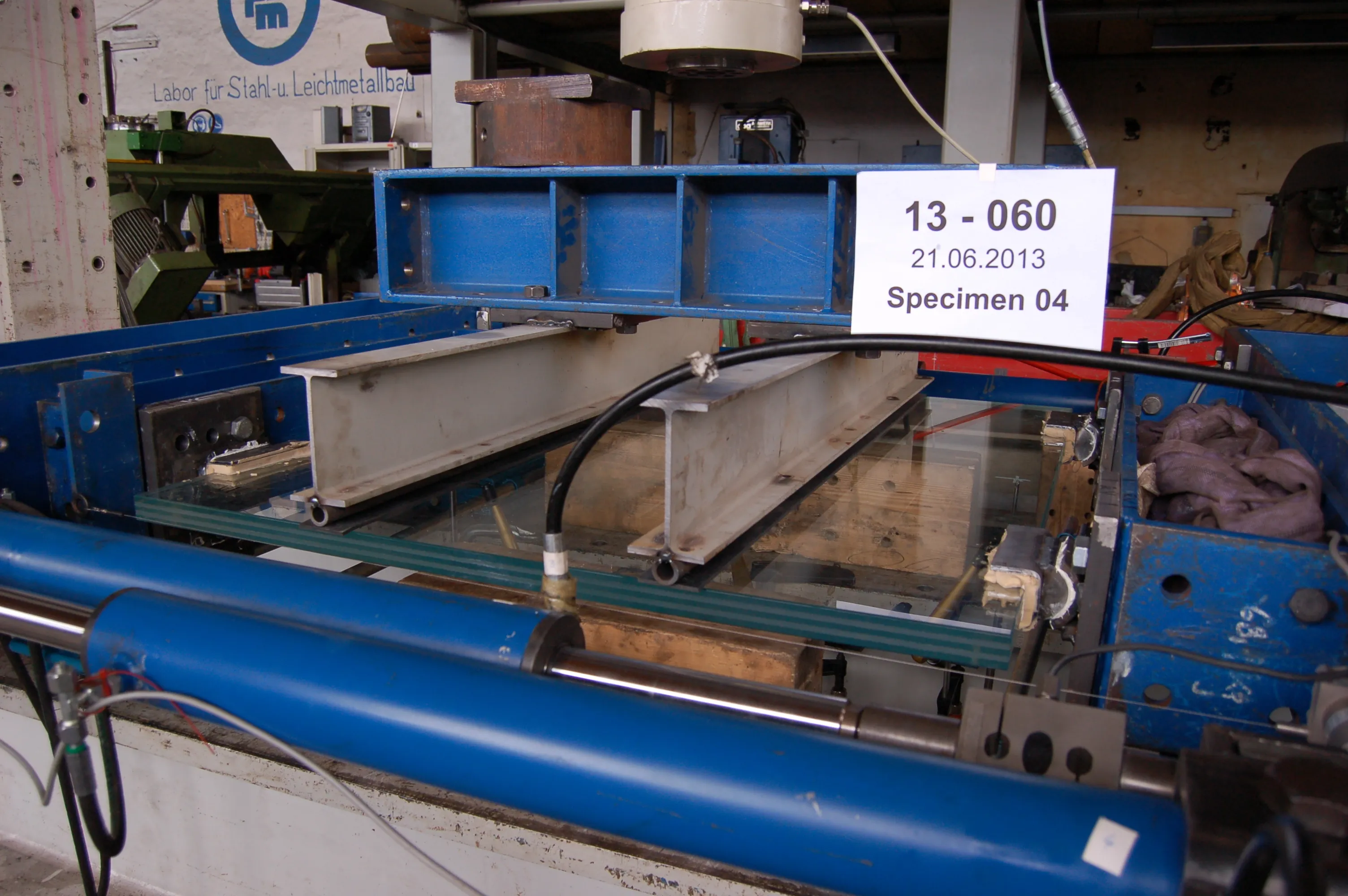
To prove the safety of load-bearing glass it is examined if the glass will stay intact when used as load-bearing material on board yachts. It is also determined how safety can be ensured when using glass with this purpose. Using the FEM model the stresses in the load-bearing glass are calculated and compared to the maximum allowable stress imposed by LR. Also, the risk and consequences of the failure of the glass are examined. The load-bearing glass stays intact under the applied loads, with a glass thickness increase of only 3% compared to the model with non-structural glass. Additionally, if all windows of this structural glass concept fail the surrounding structure will still provide a sufficient safety and will not deform plastically. This proves the safety of load-bearing glass for a feasible concept.
Additionally, an example of an application of load-bearing glass is researched. In this application mullions are eliminated and replace with a bigger window. This shows that by giving glass load-bearing purposes it is possible to eliminate mullions for it will take over part of the loads on the surrounding structure. This was done by increasing the thickness of the glass by 17%, in this case, compared to the original non load-bearing glazing.
The whole concept is presented to LR. LR mentions glass may be taken into account for structural purposes provided that the glass does not jeopardize the safety of the construction. In conclusion, it is demonstrated that the concept complies with the regulations and the safety of the concept is proven and therefore LR will very likely approve this concept when applied on a real project.
Latest