innovation
Composite reinforcement of conventional aluminium deck design
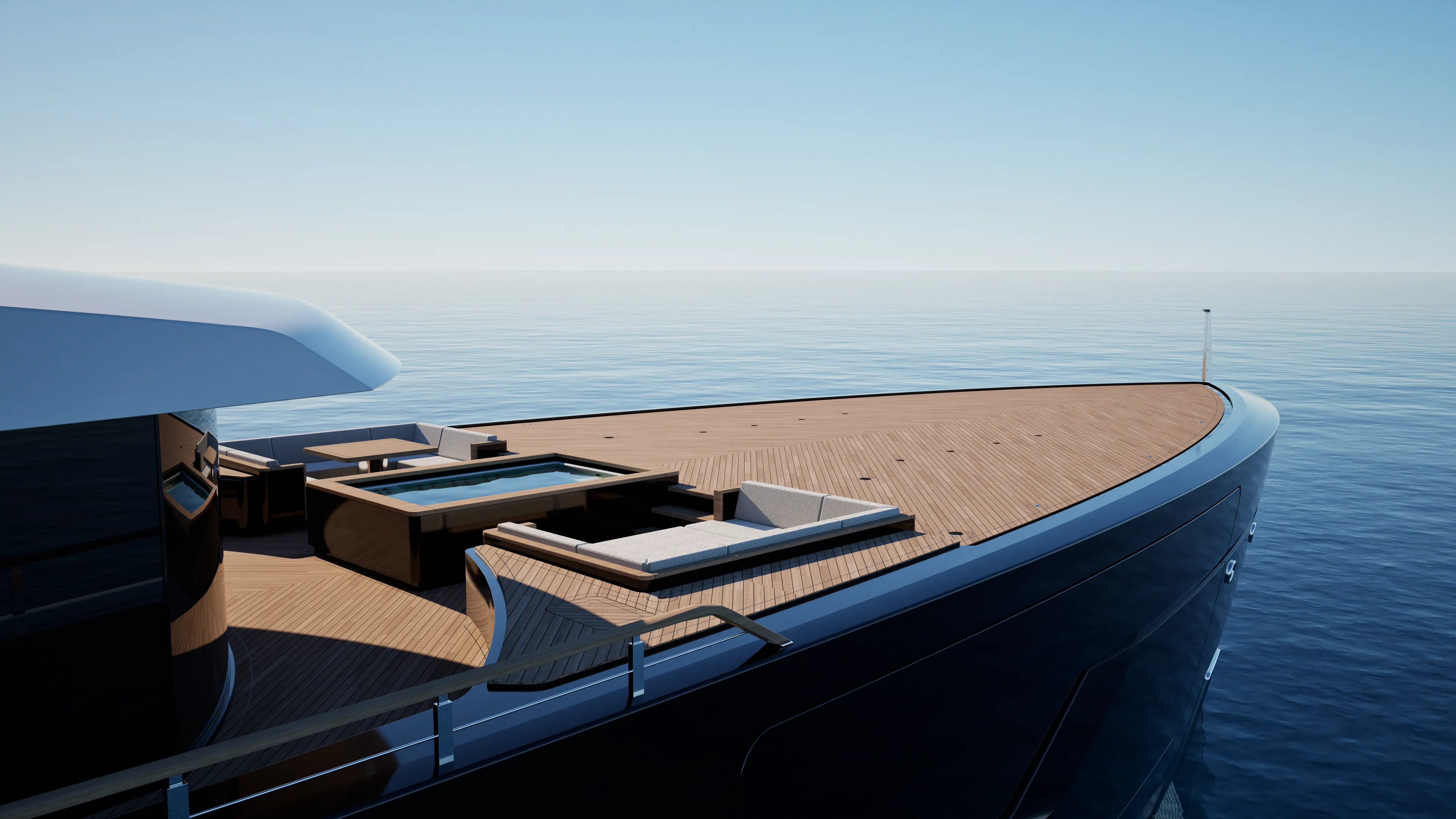
Increasing size of superyachts results in increasing unsupported deck spans in accommodation rooms, requiring larger stiffeners. This in turn reduces the available interior height and induces vibration problems. Composite stiffening of aluminium decks in the superstructures of superyachts was researched through a cost-benefit analysis, to be used as a proof-of-concept.
The aluminium structure is regarded as providing structural rigidity while the composite reinforcement is used purely to decrease the maximum deflection below allowable limits. The final solution is required to be generally applicable to aluminium deck structures, to be able to segregate research investments over multiple projects. The most feasible concept of composite reinforcement is found using an analytical analysis, which is analysed in more detail using FEM to quantify the potential benefits. Financial costs are estimated using a rough order of magnitude estimation and risks are addressed.
The most feasible concept of composite reinforcement is found through rough generalization and analytical analysis of four different concepts: top sheet reinforcement, stiffener flange reinforcement, bottom sandwich plate reinforcement and shear web stiffening. The used analytical model considers a thin, rectangular, anisotropic plate of constant stiffness and mass properties, clamped on one edge and simply supported on the other three. Stiffener contribution to deck stiffness was taken into account using the smearing technique. Optimising for total structural deck height indicated only the concepts of stiffener flange reinforcement and bottom sandwich plate reinforcement proved capable of greatly reducing the structural height within the set boundary conditions. The concept of stiffener flange reinforcement does so using the least amount of added composite and is therefore deemed the most feasible concept for detailed analysis. According to the analytical analysis, adding 5.3%in total deck mass results in a potential reduction of 27.9%in structural deck height.
Fire insulation regulations required two composite slabs to be placed on the bottom of the relevant main stiffeners’ flanges. The one-dimensional nature of stiffeners is best utilised by UD composite slabs made by pultrusion of high modulus pitch-based carbon fibre-epoxy with a fibre volume fraction of §0.63. The composite is adhered to the aluminium using high-end epoxy adhesive. Electrical insulation of the composite to account for the galvanic potential between carbon fibres and aluminium is acquired by the bond-line thickness and added glass fibre plies. Detailed analytical and FEM analyses of conventional and thermal loads indicated composite or aluminium failure is not possible, but large stresses in the adhesive arise. The exact degree of the stresses could not be determined using the available computational resources and time. The thermal loads, ¢T Æ ¡20°C and ¢T Æ Å30°C, also indicated a change in maximum deflection of up to 40% and must therefore be taken into account when designing the yacht’s interior. The relationship between increased deck span and decreased structural height is highly dependent on the deck’s geometry, but can quickly and accurately be described using a second order polynomial in both length and width directions to graphically display the potential of composite reinforced design.
Regarding additional investment costs of composite reinforcement, the constant costs account to an estimated AC36,035 per accommodation room. The estimated composite costs are 150AC/kg and are thus dependent on the aspired degree of reduction in structural height and/or increase in deck span. The risks are purely of financial nature, as the main requirement structure is to provide structural rigidity and thus a failsafe design.
In conclusion, applying two rectangular carbon-epoxy pultrusion profiles results in a feasible method of reducing structural deck height and/or increasing deck span. The costs and increased stiffness are well quantifiable within a reasonable time. The goal to analyse the potential of composite reinforced deck design in terms of decreased structural deck height and/or increased unsupported deck span through a cost-benefit analysis is therefore achieved. However, several aspects remain to be studied in more detail. Most importantly, a method has to be found to accurately model stresses in the adhesive and, where required, structural details have to be designed to reduce peak stresses below the allowable limits (for instance by chamfering the composite at the ends). Furthermore, behaviour of the composite reinforcement under cyclic (compressive) loading and during a fire must be researched in order to asses and minimise the risk of adhesive failure.
Latest