Steering towards stiffness
The superyacht industry faces an increasing trend of larger dimensions, more open spaces, larger hull openings and more exotic shapes. This puts more effort on the structural design of the yachts to maintain the high luxury standard that distinguishes superyachts from commercial marine vessels.
Especially longitudinal stiffness is important, since the luxurious interior and delicate systems installed in a superyachts are not allowed to cause creaking noises or be damaged. Inevitably, a structure deforms elastically and knowledge on the magnitude of these deformations is required to be able to design the structure in accordance with the high comfort standards belonging to superyacht customers.
Experimental observations show a direct link to the yacht sailing in waves and interior movement due to an elastically deforming structure. Therefore knowledge on the sea state that causes the loads and an accurate structural model that represents the yacht structure is essential in predicting the deformations that occur during operation. The aim of this thesis is to establish a method that can provide more insights in the magnitude of the structural deflections and rotations in operating conditions of Feadships to use for risk assessment and provides guidance on clearances or connections that should be used for interior instalment.
The determination of deformations considers the wave-induced loads acting on the hull structure and the structural characteristics of the yacht. A potential flow strip method is used in this thesis to determine the linear response of a yacht to a sea state represented by a standard JONSWAP spectrum. A regular equivalent design wave is used to obtain design load distributions that represent the most extreme or most probable loading distribution the yacht experiences for a set of operation parameters such as heading angle and speed. The yacht structure is modelled excluding the superstructure as a Timoshenko beam including shear deformations and torsion and its global and local deformation response is verified with commercial software.
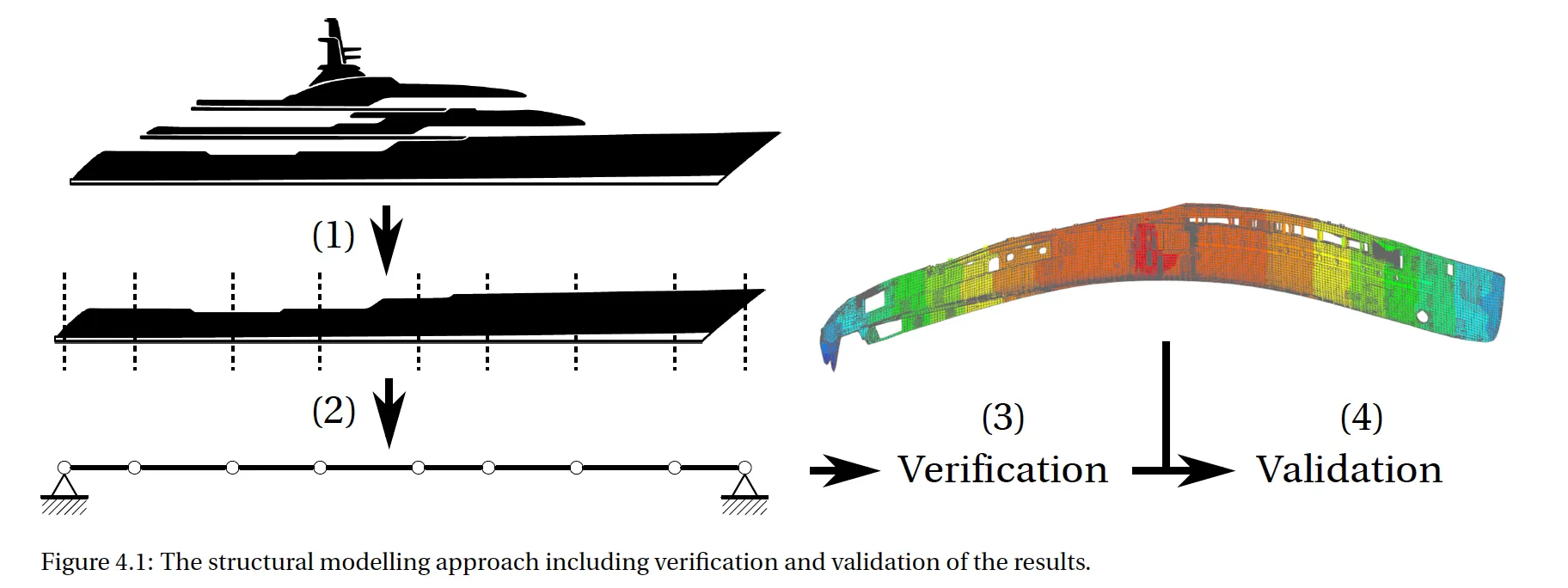
Validation is done by comparison of the structural response of the beam model with a 3D detailed Finite Element (FE) model response of a test case yacht subjected to classification society rule loads. The design load distributions are then applied to the beam model to obtain global and local deformation estimates of the yacht structure in a realistic sea state. The deformations can be compared to limit values to indicate structural risks and provide magnitude for the clearances and connections that should be adopted for the interior.
The operational load distributions derived with the equivalent design waves match in shape and order of magnitude with the rule design loads. Maximum vertical and horizontal bending moments are observed to be amidships and the maximum torque is observed to be more aft at approximately 25% of the length between perpendiculars. The equivalent design wave can generate concurrent load distributions that occur for heading angles smaller than 180° to indicate what deformations occur in or out of phase with each other.
The beam model showed good agreement with the 3D FE model for the global displacements and rotations for the vertical and horizontal and the longitudinal rotation for the torque. Including the shear deformations in the beam model resulted in an increase of 20% for the maximum vertical displacement, reducing the stiffness significantly. The local response is derived from the global response and three main deformation components are calculated: the bulging, expansion/contraction of horizontal structural elements caused by vertical bending and the vertical displacement due to torsion of the hull girder. The local deformation components are compared to the deformation in the 3D FE model and a good agreement is found.
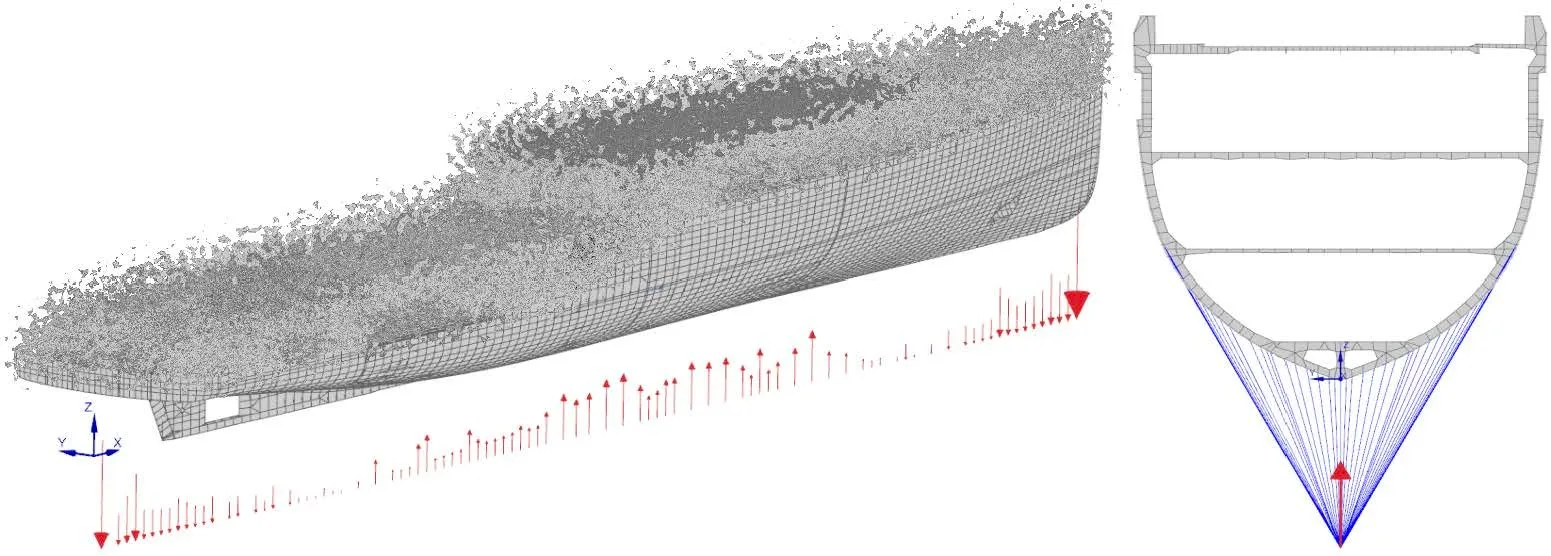
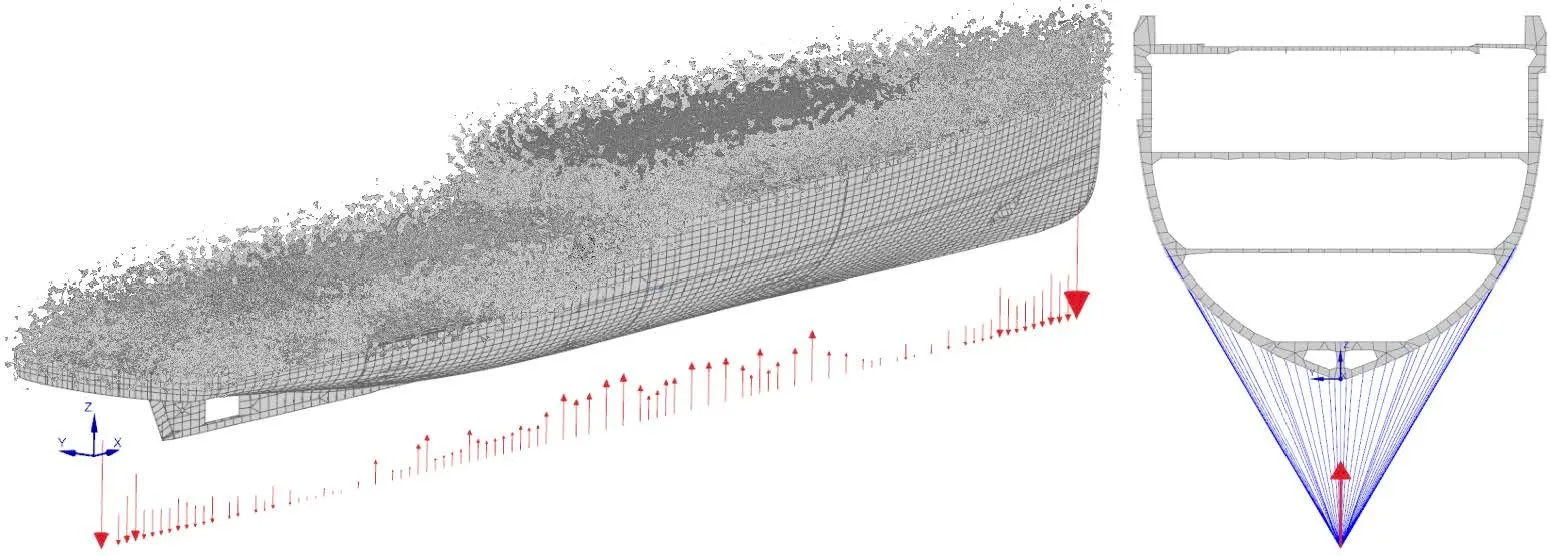
Figure 4.10: The load application by discrete forces and the distribution over nodes with a RBE3 spider element.
The operational load distributions and the beam model are combined to create a longitudinal distribution of the deformation components that can indicate whether excessive deformation will occur in a longitudinal section of the yacht. Also, the deformation components can directly indicate what measures should be taken to install the interior with proper clearance or connections.
Latest