design
Design exploration with design drivers
When your dream yacht is being built at Feadship, the process starts with a blank page. This early stage is defined as the sales phase. In consultation with a designer, the look and feel of a yacht is easily captured. The expertise of the designer will lead to a yacht fitting the vision of the client. In the current process, the lines drawn on paper restrict the design freedom of the naval architect. Next to that, not all consequences of decisions are known, which leads to the probability of alterations in later phases.
The current design method is called a point-based method. A single starting point is chosen, which is gradually refined in a couple of iterations, see left side Figure 1. This method has some disadvantages. Every iteration will bring rework when design requirements are altered. Time and budget constraints will limit the number of iterations. Next, the solution is always based on the starting point, meaning that the solution is bounded to a small part of the design space. Finally, the design decisions made early in the process restrict the process due to the available information in an early design stage.
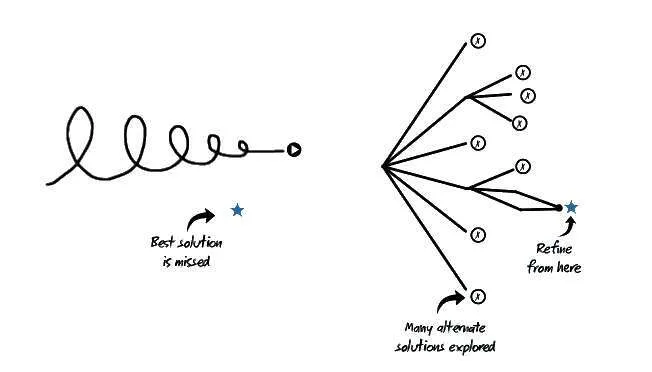
Figure 1: Point-base refinement (left) versus set-based design exploration (right)
Design exploration is a method in which many solutions are generated in a design space and no single starting point is chosen, see right side Figure 1. The main focus of this approach is to postpone the design decisions until they can be made with the required knowledge. This will prevent alterations and rework in future phases. In this research, there is investigated whether design exploration could be implemented in the Sales phase at Feadship, using design drivers for the exploration method. The design driver origin from the stakeholders (client, regulatory bodies and Feadship) and are used to structure the design requirements and to evaluate the solutions. Implementing design exploration will require three steps:
- Creating a design space.
- Explore and evaluate the solutions.
- Select the best fit.
Creating the design space is done with help of a simple Design Model. Due to the limitations of the Sales phase this model is built with help of regression lines, empirical formulas and rules of thumb. The set of solutions are explored with eight design drivers which originated from the stakeholders and Sales process: Aesthetics, Usage, Performance, Rules, Costs, Space, Comfort and Safety. The design drivers are categorised into three parts: input, constraint and output. The input will follow from the client, where the constraints will follow from the other two stakeholders. The final choice for the output is made by the client, which can be underpinned with help of the output design drivers. To validate the design space and the design drivers, design cases are performed. These cases consist of two existing designs which just left the Sales phase. This investigation shows whether the design space has enough variation and results in comparable solutions. The design space consists of approximately 4.4 million solutions of which 3.2 million feasible.
This research concludes that design exploration could be an improvement on the current used point-base design method. Since design exploration fully utilises the design freedom available in the early stage design. The solutions produced by the Design Model show reasonable results, which lie within a 10% margin of the existing designs. Due to the limitations of the Sales phase the choice was made to use regression lines. As a result, the design space consists of solution sof which the trend is clearly visible. Nevertheless, the variety within the design space is sufficient enough to create a diversity in solutions. The results produced by the Design Model will be a good starting point in the starting phase. In order to use the results as more than a starting point, the detail level of the calculation methods should be improved. Generating a set of solutions will enable the designer and client to make well-informed decisions, which reduce the risks of alteration in later phases. Especially when the client is involved in this process.
Using design drivers proves to be a good method to structure the wishes of a client and evaluate the solutions within the design space. All design drivers, except Safety, should be taken into account in the current detail level. The design driver Safety does not drive any solution within the design space. When the level of detail of the calculation methods have increased, the definition of the design drivers should be evaluated. The possibility exists that the design driver Safety would be of importance again.
A big advantage of design explorations is creating a design space with a set of starting points and postpone critical decisions. Currently, the design freedom is restricted due to the use of regression lines. In future work, there will be recommended that the calculations are done in more detail and a 3D parametric hull modeller is required.
Latest