Design of a Feadship Modular Product Platform
Is below 60 metres still a profitable size for Feadship?
Feadships vary in length between 40 and 120 metres, but the yachts under 60 metres have become increasingly less in the past years due to attractively price them in the current competitive market. To compete in the range under 60 metres, the cost price will have to be reduced. For Feadship, the market under 60 metres is interesting for two reasons: large demand and returning customers. The market for yachts under 60 metres is almost three times larger than the market above 60 metres. Of the yachts 80-90% are standard or semi-standard. Therefore, this market has a high potential for Feadship, if they can develop a semi-custom yacht that is attractively priced. Furthermore, a large part of yacht owners that own a 60+ metres yacht previously owned a yacht below 60 metres. If Feadship can offer a yacht below 60 metres they are more likely to return at Feadship for a larger yacht. To reduce the cost price, the possibilities of design reuse are investigated. The following main question will be answered: How can design reuse be applied to a 50-60 metres Feadship, with the aim to reduce engineering costs, while maintaining Feadship’s customer value?
Feadship is an engineer to order company (ETO). The customer order decoupling point (CODP) is at the start of the process. This indicates that the customer is involved from the very beginning. Design reuse enables the postponement of the CODP, if done correctly this will result in a reduction of costs. To identify the best parts for reuse, the diversity in existing yachts in this range is analysed. Furthermore, the customer value and engineering hours in a yacht are used together, to identify potential areas for reuse.
The existing yacht analysis identified five possible general arrangements and a set of rooms commonly found in this range of yachts. Furthermore, minimum and maximum values for: the amount of crew, guests, range, engine power and tenders are derived from existing yachts. These are used as requirements for the design reuse solution. The coupling of engineering activities and customer value showed five areas of interest for design reuse. These areas are: hull and powering, regulations for the naval architect, construction, mechanical systems and crew interior.
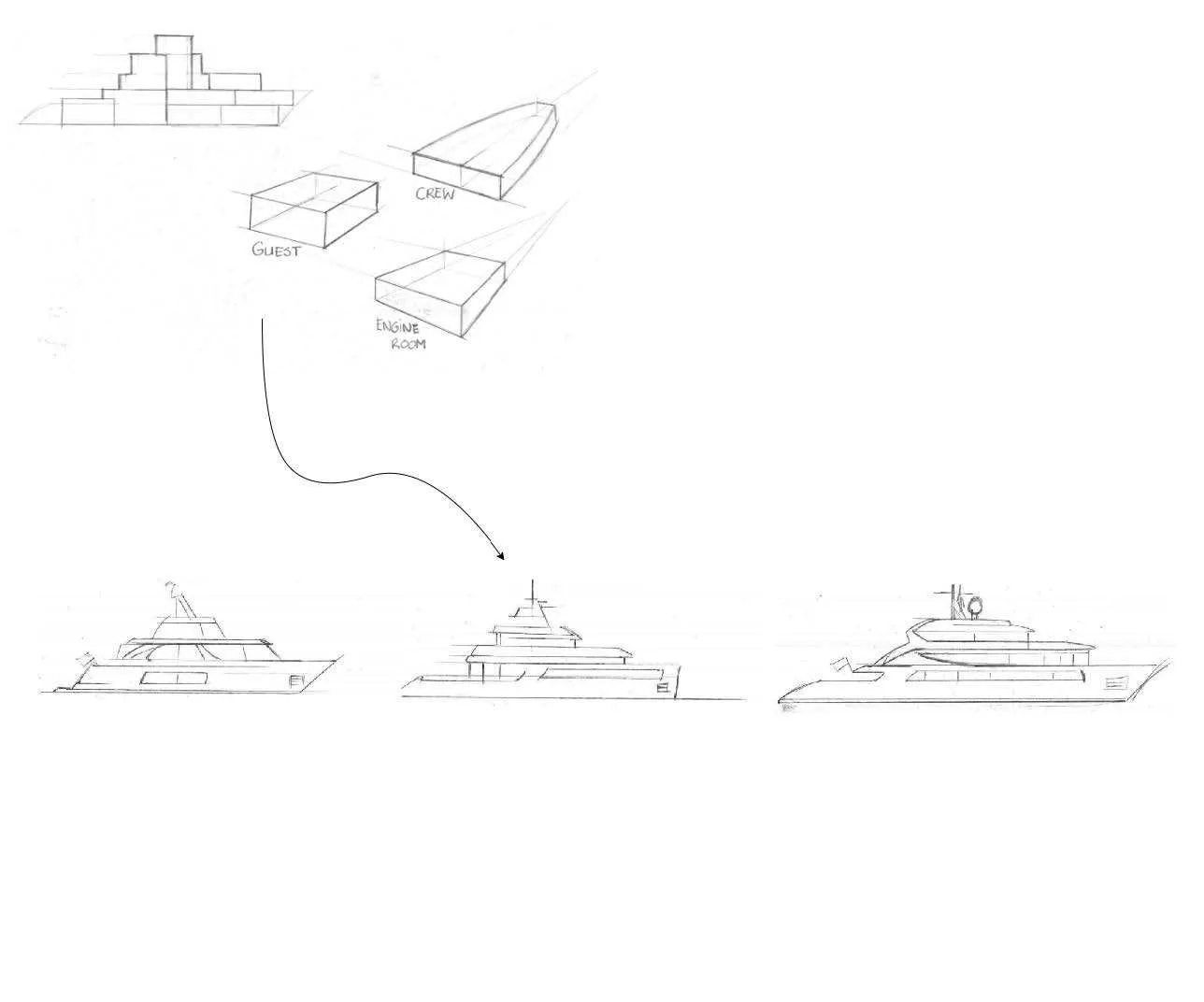
The possible design reuse option applied in this thesis uses modularity and will be referred to as: Feadship modular product platform. The Feadship modular product platform combines three integral platforms and eleven modules. Figure 1 shows the three integral platforms and table 1 lists the different modules. The integral platform forms the skeleton of the yacht, it provides the structural strength and includes the main technical components. For example, the engine room, propulsion pods, tanks, ac-units and the main ducting are part of the integral platform. The platform is divided in compartments of which some have a variable length. This enables the Feadship modular product platform to have a length between 50 and 60 metres. In the compartments, modules can be placed. Some have a fixed location and interior arrangement, whereas others can be customised within the available area. The modules consist of the interior finish and local technical solutions. For example, local HVAC ducting is designed within the module. The local ducting is connected via standardised connections to the platform.
The Feadship modular product platform can have a length between 50 and 60 metres and a beam of 10.15 metres. The modular yacht can accommodate a minimum of 6 and maximum of 12 guests and 10 to 16 crew. Furthermore, there are two possible engine configurations: 2x990 kW or 2x 1480 kW. Lastly a maximum of two 8 metre tenders can be stored. More customisation is possible on interior and exterior. The interior customisation level is different for each module. All crew modules have a standard interior arrangement, but the luxury modules such as lounges, guest rooms and owner’s area can be customised within an available area. The exterior customisation is achieved by offering a variable deck length and not reusing the local exterior details. The variable deck length is achieved by increasing or reducing lounge areas. This will influence the longitudinal profile of the yacht. The local exterior details, such as the bulwark, transom and mast, will not be reused but customised for each yacht.
Even with this level of customisation, enough of the design can be reused to reduce engineering hours. In total a reduction of 25% of the hours in naval architecture, 36% of the construction hours, 64% of the mechanical engineering hours and 42% of the hours spent on interior is possible. The concept makes it possible to reduce the total engineering hours at De Voogt by 29%. This is possible because of the standardisation in crew and technical areas. Furthermore, a parametric construction and hull model to cope with the different sized compartments contribute to the savings. More savings are to be expected in the detailed engineering and in the production. For the production an estimate is made using a learning rate of 95% for each doubling of the amount of yachts built. It is estimated that 6 yachts will be sold in the coming 10 years. If the yacht’s selling price is 95% of a normal custom yacht and engineering costs for the first yacht increase by 50% because of engineering for modularity. Feadship will have to sell 5 yachts to earn back the initial investment in the platform.
Latest